
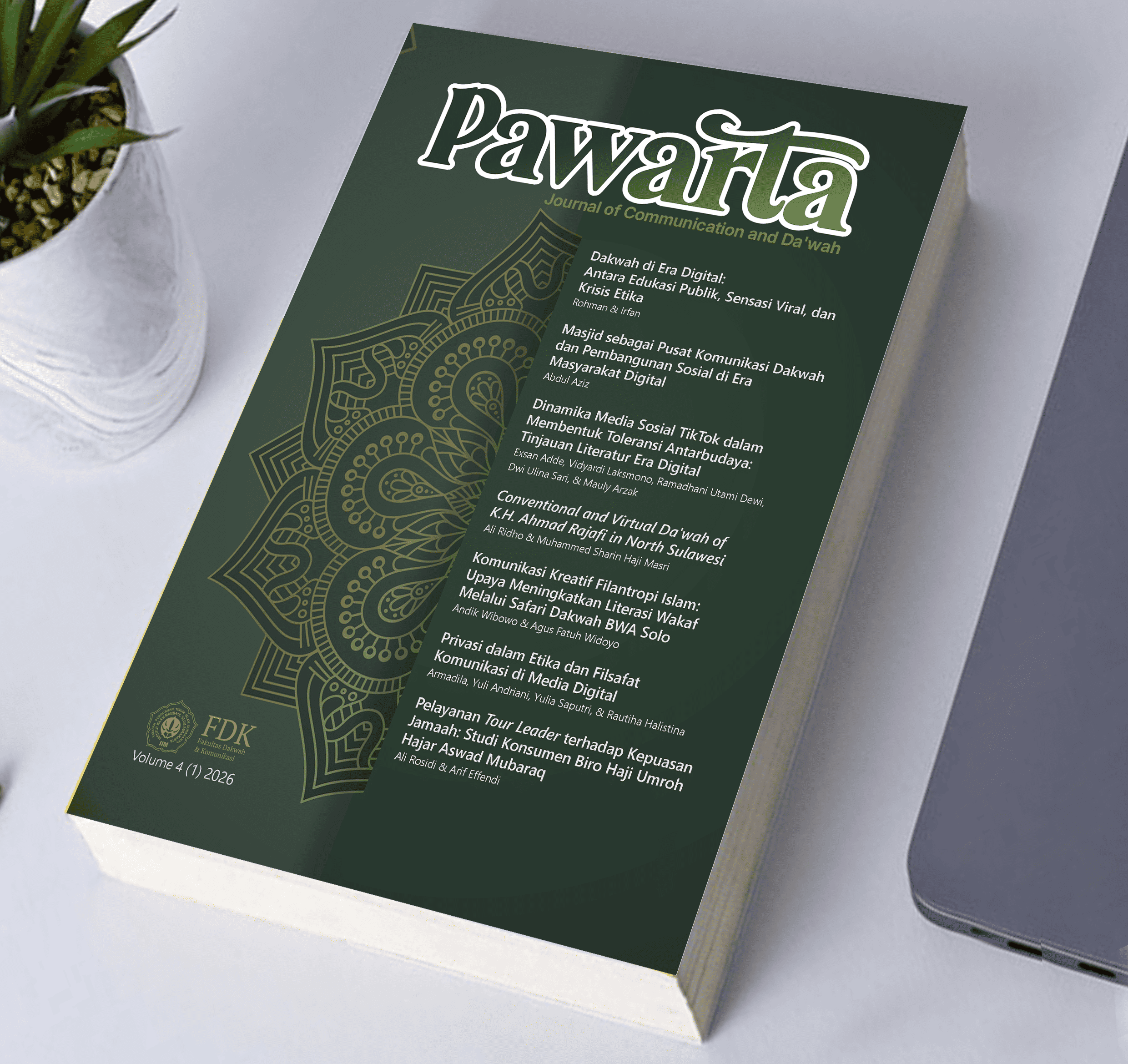
Dinamika Media Sosial TikTok dalam Membentuk Toleransi Antarbudaya: Tinjauan Literatur Era Digital
DOI:
https://doi.org/10.54090/pawarta.1017Keywords:
Tiktok, Intercultural Communication, Tolerance, Social Media, Digital identity, StylizationAbstract
The evolution of digital technology, particularly the TikTok platform, has transformed the landscape of intercultural communication into a global discursive space for the expression and negotiation of complex identities. This study critically analyzes TikTok's role in shaping intercultural tolerance by questioning the effectiveness of algorithms amidst the risks of information bias and stereotypes. The research method employed is a qualitative literature study with thematic analysis techniques applied to 12 selected scientific articles indexed in SINTA and Scopus (2020–2025). The results indicate that TikTok functions as a performative arena where users construct digital personas through stylization and code-mixing strategies to enhance intercultural sensitivity. However, this study asserts a contradiction in algorithmic mechanisms that potentially reinforce fragmented cultivation patterns and the dominance of specific cultures (digital imperialism). These findings identify that the platform's effectiveness in fostering substantive tolerance heavily relies on the synergy between users' critical media literacy and the development of inclusive content to minimize communication conflicts.
Downloads
References
Chen, S. (2024). The Impact of Tiktok Short Videos on Minors under the Perspective of Cultivation Theory. Research and Commentary on Humanities and Arts, 2. https://doi.org/10.18686/rcha.v2i2.4024
Deardorff, D. K. (2023). Intercultural Competence. https://doi.org/10.1093/obo/9780199756841-0293
Deng, T., Vargas-Bianchi, L., & Mensa, M. (2023). Cross-Cultural comparison of TikTok uses and gratifications. Behaviour and Information Technology, October 2023, 1–13. https://doi.org/10.1080/0144929X.2023.2270534
Etri, W. (2023). Employing Bennett’s Developmental Model of Intercultural Sensitivity (DMIS) to Understand Intercultural Sensitivity in ELT. World Journal of English Language, 13(1), 39–53. https://doi.org/10.5430/wjel.v13n1p39
Firamadhina, F. I. R., & Krisnani, H. (2021). PERILAKU GENERASI Z TERHADAP PENGGUNAAN MEDIA SOSIAL TIKTOK: TikTok Sebagai Media Edukasi dan Aktivisme. Share : Social Work Journal, 10(2), 199. https://doi.org/10.24198/share.v10i2.31443
Haji, R., & Noguchi, H. (2020). Indirect Contact Interventions to Promote Peace in Multicultural Societies. 57–70. https://doi.org/10.1007/978-3-030-22176-8_4
Haryanto, R., & Kurnia, H. (2024). Pengaruh Komunikasi dan Interaksi antar Budaya terhadap Kesadaran Toleransi Siswa di SMA Negeri 5 Yogyakarta. Civics Education and Social Science Journal (CESSJ), 6(2), 119–132.
Junaeda, A. A., & Sayogie, F. (2025). Intercultural Communication Conflict Between British and Americans in TikTok Memes. Media Education (Mediaobrazovanie), 21(1), 54–60. https://doi.org/10.13187/me.2025.1.54
Kusyairi, Hikmah, & Nurul Qomariyah. (2024). Use of Language Variations on Tiktok Social Media in Generation Z. INTERDISIPLIN: Journal of Qualitative and Quantitative Research, 1(3), 140–153. https://doi.org/10.61166/interdisiplin.v1i3.33
Lai, C., & Cai, S. (2023). The nature of social media use and ethnic minorities’ acculturation. International Journal of Intercultural Relations, 96, 101852.
Morejón-Llamas, N., Ramos-Ruiz, Á., & Cristòfol, F. J. (2024). Institutional and political communication on TikTok: Systematic review of scientific production in Web of Science and Scopus. Communication and Society, 37(2), 159–177. https://doi.org/10.15581/003.37.2.159-177
Nabila, S., Adinda Putri, E., Mullya Putri, P., Aliza Putri, V., & Khairi, Y. (2024). Pengaruh TikTok Terhadap Ekspresi Budaya: Perspektif Sosiokultural. Jurnal Humaniora, Ekonomi Syariah Dan Muamalah (JHESM), 2(2), 114–121.
Oktarina, O., Sarmiati, S., & Asrinaldi, A. (2022). Globalisasi dan identitas budaya Indonesia melalui aplikasi tiktok. JRTI (Jurnal Riset Tindakan Indonesia), 7(2), 277. https://doi.org/10.29210/30031775000
Polanco, N., Mayorga, B. V. S., Prince, J., & Benel, A. (2022). Tik Tok and the possible perseverance of Cultural Imperialism. Global Media Journal, 20(52), 1–7. https://doi.org/10.36648/1550-7521.20.52.312
Rahmawati, M. A., Purwanto, E., Widiyaniarti, T., & Wandiah, K. P. (2024). Komunikasi Antar Budaya di Era Digital. 2(10), 307–313.
Salsabila, F. L., Widiyanarti, T., Ashari, S. D., Zahra, T., & Ayu, S. (2024). Pengaruh Globalisasi terhadap Perubahan Komunikasi antar Budaya pada Generasi Z Pola. 4, 1–13.
Schellewald, A. (2021). Communicative Forms on TikTok: Perspectives From Digital Ethnography. International Journal of Communication, 15, 1437–1457.
Wahyudin, A. (2023). Communicating the Message Analysis on Tiktok @Huseinjafar to Maintain Interfaith Tolerance. Jurnal Ilmiah LISKI (Lingkar Studi Komunikasi), 9(2), 107. https://doi.org/10.25124/liski.v9i2.6457
Yang, Y. (2022). TikTok/Douyin Use and Its Influencer Video Use: A Cross-Cultural Comparison Between Chinese and US Users. Online Media and Global Communication, 1(2), 339–368. https://doi.org/10.1515/omgc-2022-0016
Downloads
Published
How to Cite
Issue
Section
License
Copyright (c) 2026 Exsan Adde, Vidyardi Laksmono, Ramadhani Utami Dewi, Dwi Ulina Sari, Mauly Arzak

This work is licensed under a Creative Commons Attribution 4.0 International License.


