
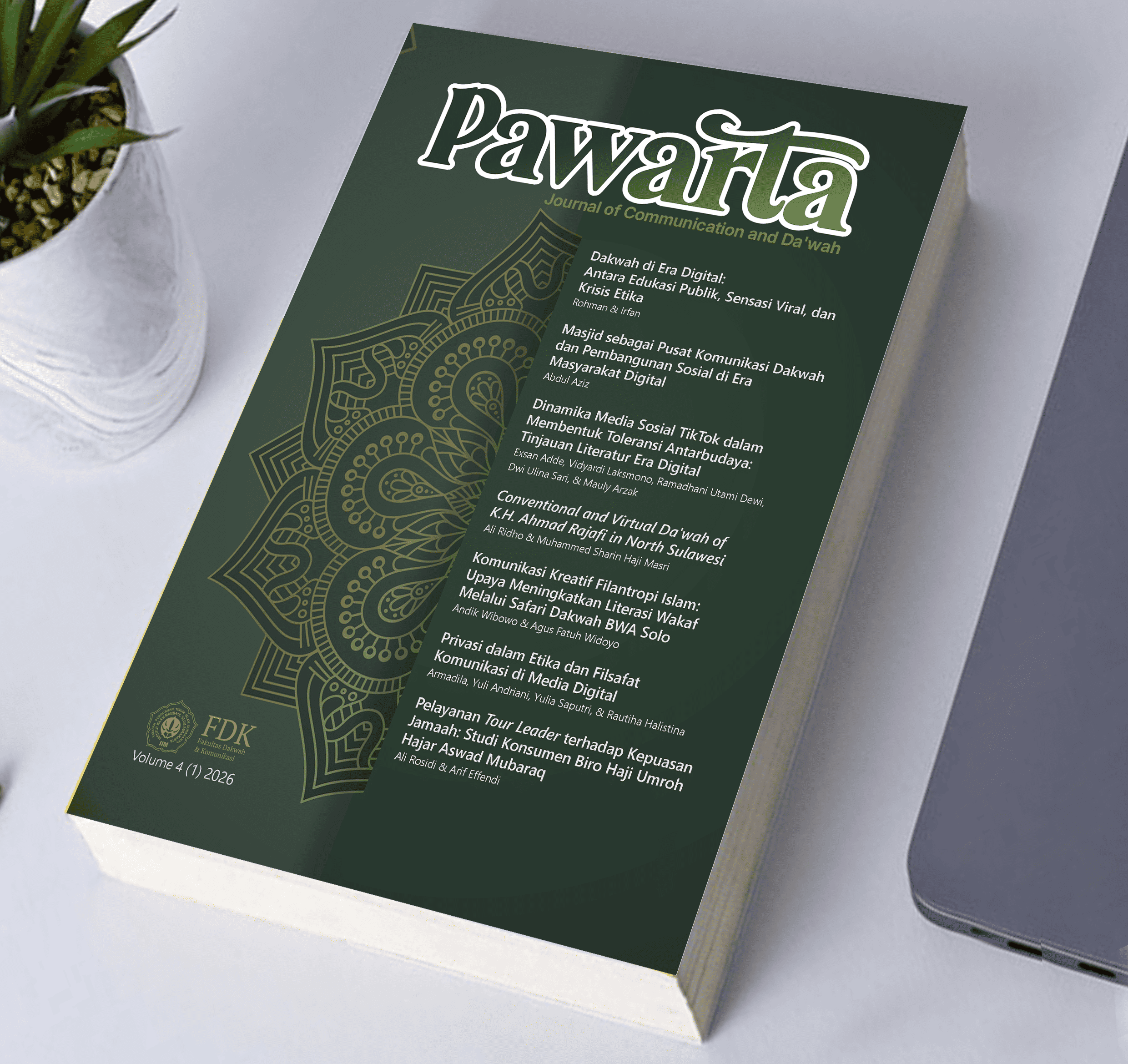
Dakwah di Era Digital: Antara Edukasi Publik, Sensasi Viral, dan Krisis Etika
DOI:
https://doi.org/10.54090/pawarta.1028Keywords:
algorithms, digital da'wah, ethics, social mediaAbstract
This study aims to examine the dynamics of Islamic preaching ethics on social media by highlighting the tension between educational and popularity orientation. The preaching transformation to the digital space presents opportunities for wider dissemination, but at the same time poses risks of substance reduction, commodification of religion, and a shift in religious authority. The research focuses on how preachers and audiences negotiate the value of preaching in a competitive algorithmic ecosystem. A qualitative approach was used with three main techniques: analysis of da'wah video content on YouTube, TikTok, and Instagram; in-depth interviews with preachers and audiences; and virtual observation of digital interactions. Data validity maintained through sources and methods triangulation. The findings reveal that digital da’wah operates within a spectrum of education and popularity, where sensational content often deviates from ethical standards, audiences face ambiguity in assessing quality, and religious authority shifts from scholarly legitimacy to algorithm-driven popularity. Nevertheless, ethical practices can be maintained through creative adaptation strategies such as storytelling, visualization, and healthy interaction with audiences. The main contribution of this study is the development of an ethical framework for digital da’wah that is adaptive to algorithmic logic while preserving scholarly substance, thereby offering a new perspective for the study of Islamic preaching in the social media era. This study concludes that the ethics of Islamic preaching in the digital era are not merely a matter of right or wrong according to religious law, but rather a strategy of adaptation to the logic of virality. The main contribution of this research lies in the formulation of a relevant, critical, and operational ethical framework for digital da’wah, which can serve as a reference for preachers, audiences, and religious institutions in maintaining the integrity of preaching within the digital public sphere.
Downloads
References
Aaker, J. L. (1997). Dimensions of Brand Personality. Journal of Marketing Research, 34(3), 347–356. https://doi.org/10.1177/002224379703400304
Adara, R. A. (2020). Improving Early Childhood Literacy by Training Parents to Utilize Digital Storytelling. Proceedings of the International Conference on Early Childhood Education and Parenting 2019 (ECEP 2019). https://doi.org/10.2991/assehr.k.200808.039
Adde, E., Yansah, S., & Solihin, M. (2025). Komunikasi Antarbudaya dalam Dakwah Digital: Pendekatan Islam Terhadap Tantangan Globalisasi. AT-TABSYIR: Jurnal Komunikasi Penyiaran Islam, 12(2), 189–206. https://doi.org/dx.doi.org/10.21043/at-tabsyir.v12i2.32621
Akbar, Hermanto, E., & Irfansyah, M. S. (2025). Kontroversi Dakwah Gus Miftah: Memahami Batasan Humor dan Etika Komunikasi Dalam Al-Qur’an (Analisis QS. An-Nisa Ayat 63). Madani: Jurnal Ilmiah Multidisiplin, 3(1), 603–609. https://doi.org/10.5281/zenodo.14636161
Alhasbi, F., Faraba, K. S. A., Effendi, A., Utomo, B. I., Bachtiar, F., & Azizah, U. N. (2024). Dakwah Digital: Publikasi Kegiatan Masjid Memanfaatkan Jejaring Sosial. Ngarsa: Journal of Dedication Based on Local Wisdom, 4(2), 99–114. https://ngarsa.uinkhas.ac.id/index.php/ngarsa/article/view/517
Amin, E. (2017). Etika Dakwah: Kontekstualisasi Dakwah Profesional. TAJDID: Jurnal Ilmu Ushuluddin, 16(1), 19–34. https://doi.org/10.30631/tjd.v16i1.52
Amin, M. S. (2025). Pengaruh Algoritma Media Sosial Terhadap Narasi keislaman di Ruang Digital. El-Wasathy: Journal of Islamic Studies, 3(1), 148–158. https://doi.org/10.61693/elwasathy.vol31.2025.148-158
Arbiah, Armita Sari, N., & Mukmin. (2025). Studi Islam dalam Konteks Pembelajaran di Era Digital: Tantangan Diskursus Keagamaan Kontemporer. Chalim Journal of Teaching and Learning, 5(2), 141–154. https://doi.org/10.31538/cjotl.v5i2.2764
Asbi, M., Firdaus, S. F., & Hamidah, L. (2025). Strategi dan Pendekatan Dakwah di Era Digital pada Pemikiran Al Bayanuni. Jurnal An-Nida, 17(1). https://doi.org/10.34001/an-nida.v17i1.7437
Azis, A. R., & Fahmi, F. (2021). Etika Dakwah dan Media Sosial. Alhaqiqa: Jurnal Komunikasi Dan Penyiaran Islam, 5(1), 31–40. https://doi.org/10.36915/alhaqiqa.v5i1.145
Azzahro, F., & Fasha, J. (2025). Literasi Media Digital dalam Dakwah Islam. ANWARUL, 5(5), 701–713. https://doi.org/10.58578/anwarul.v5i5.7645
Creswell, J. W., & Creswell, J. D. (2018). Research Design: Qualitative, Quantitative, and Mixed Methods Approaches (5th ed.). SAGE Publications, Inc.
Fakhruroji, M. (2019). Digitalizing Islamic lectures: Islamic apps and religious engagement in contemporary Indonesia. Contemporary Islam, 13(2), 201–215. https://doi.org/10.1007/s11562-018-0427-9
Gillespie, T. (2019). Custodians of the Internet: Platforms, Content Moderation, and the Hidden Decisions That Shape Social Media. Yale University Press. https://doi.org/10.12987/9780300235029
Ilham, Muliana, S., Sihombing, S. M., Rahmitha, S., & Sirait, A. K. (2025). Pemanfaatan Media Sosial sebagai Alat Komunikasi dalam Meningkatkan Efektivitas Dakwah di Era Digital. Socius: Jurnal Penelitian Ilmu-Ilmu Sosial, 2(10), 84–91. https://doi.org/10.5281/zenodo.15359036
Jung, A.-K., Stieglitz, S., Kissmer, T., Mirbabaie, M., & Kroll, T. (2022). Click me…! The influence of clickbait on user engagement in social media and the role of digital nudging. PLOS ONE, 17(6), e0266743. https://doi.org/10.1371/journal.pone.0266743
Klug, D., Qin, Y., Evans, M., & Kaufman, G. (2021). Trick and Please. A Mixed-Method Study On User Assumptions About the TikTok Algorithm. 13th ACM Web Science Conference 2021, 84–92. https://doi.org/10.1145/3447535.3462512
Kumala, N. (2021). Al-Qur’an dan Etika Dakwah Virtual. Jurnal Dakwah, 21(1), 59–84. https://doi.org/10.14421/JD.2112020.5
Miles, M. B., Huberman, A. M., & Saldaña, J. (2014). Qualitative Data Analysis: A Methods Sourcebook (3rd ed.). SAGE Publication, Inc.
Nawaffani, M. M. (2023). Dakwah Digital dan Dakwah Mimbar: Analisis Peran dan Dampak dalam Era Digitalisasi. Sanaamul Quran : Jurnal Wawasan Keislaman, 4(2), 143–161. https://doi.org/10.62096/sq.v4i2.57
Ronaydi, M. (2023). Personal Branding Dai Muda di Media Sosial: Pendekatan Konsep Unsur-Unsur Dakwah. Idarotuna, 5(2), 96. https://doi.org/10.24014/idarotuna.v5i2.25535
Samsudin, D., & Putri, I. M. (2023). Etika dan Strategi Komunikasi Dakwah Islam Berbasis Media Sosial di Indonesia. Ath-Thariq: Jurnal Dakwah Dan Komunikasi, 7(2), 125–138. https://doi.org/10.32332/ath-thariq.v7i2.7474
Syakur, A., Melina, R. W., Ramadhan, M. T., & Qotimah, R. Q. (2022). Media Sosial sebagai Sarana Dakwah Modern Dosen dan Mahasiswa Prodi KPI Fakultas Dakwah dan Komunikasi UIN Sunan Ampel Surabaya: Analisis Faktor Pendukung Dakwah melalui Media Online [UIN Sunan Ampel Surabaya]. http://repository.uinsa.ac.id/id/eprint/2317/
Downloads
Published
How to Cite
Issue
Section
License
Copyright (c) 2026 Rohman, Irfan

This work is licensed under a Creative Commons Attribution 4.0 International License.


