
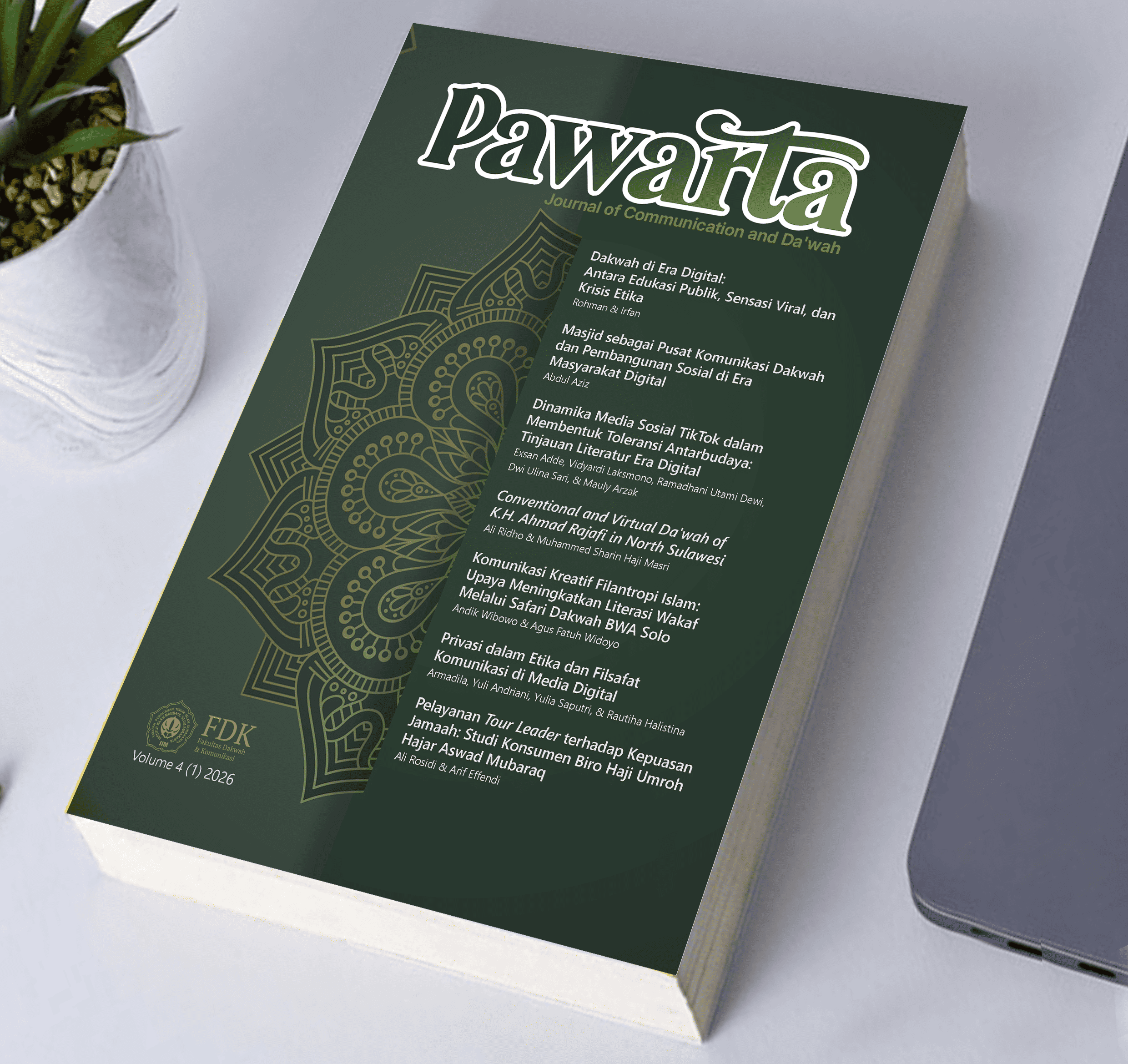
Conventional and Virtual Da'wah of KH. Ahmad Rajafi in North Sulawesi
DOI:
https://doi.org/10.54090/pawarta.1030Keywords:
Da'wah, Conventional, Virtual, Ahmad Rajafi, Dawah, conventional dawah, virtual dawah, ahmad rajafiAbstract
The research examines how K.H. Ahmad Rajafi conventional and virtual da'wah in the North Sulawesi region. Da'wah in the midst of conditions and situations of a society that has a high level of multicultural and multi-religious has its own challenges and opportunities. The research subject is a charismatic Muslim cleric and scholar, K.H. Ahmad Rajafi. This research is a comparison between field research and virtual ethnography using a descriptive qualitative approach. The results of the study found that K.H. Ahmad Rajafi da'wah is divided into two, namely: First, the conventional form is in the form of recitation, majelis taklim, tabligh akbar, and kitab kuning studies. Second, the virtual form is carried out through social media youtube, facebook, and instagram in the form of Islamic motivational content, hadith studies, and yellow book studies. K.H. Ahmad Rajafi packages his da'wah material by prioritizing educational and inspirational values that can be accepted by cross-generations ranging from baby boomers to gen Z, then they use learning materials and increase religious literacy to be applied. The challenges that are present in K.H. Ahmad Rajafi da'wah are the differences in culture and tradition, the potential for social pressure, and the lack of religious literacy level of mad'u.
Downloads
References
A’thoina, I., & Al-Aboosi, A. M. M. (2024). Navigating Digital Da’wah: Hanan Attaki’s Approach and Nahdlatul Ulama’s Authority on Social Media. Penamas, 37(2), 158–171. https://doi.org/10.31330/penamas.v37i2.822
Akmaliah, W., & Burhani, A. N. (2021). Digital Islam in Indonesia: The Shift of Ritual and Religiosity during Covid-19. ISEAS Perspective, 107, 1–12.
Al Qurtuby, S. (2020). The Rise of Islamism and the Future og Indonesian Islam. Journal International Studies, 16, 105–128. https://doi.org/10.32890/jis2020.16.7
Alam, L., Setiawan, B., Harimurti, S. M., Miftahulhaq, M., & Alam, M. (2023). The changing piety and spirituality: a new trend of Islamic urbanism in Yogyakarta and Surakarta. Indonesian Journal of Islam and Muslim Societies, 13(2), 227–252. https://doi.org/10.18326/ijims.v13i2.227-252
Alhasbi, F., Faraba, K. S. A., Effendi, A., Utomo, B. I., Bachtiar, F., & Azizah, U. N. (2024). Dakwah Digital: Publikasi Kegiatan Masjid Memanfaatkan Jejaring Sosial. Ngarsa: Journal of Dedication Based on Local Wisdom, 4(2), 99–114. https://ngarsa.uinkhas.ac.id/index.php/ngarsa/article/view/517
Anugerah, P. (2017, December 23). Tradisi ganjil makan daging “menakutkan” di Sulawesi Utara dan harga lingkungannya. BBC Indonesia. https://www.bbc.com/indonesia/majalah-42442051
Asrori, A. M. (2023, August 30). Syekh Yusri dari Mesir, Sosok Dokter sekaligus Mursyid Tarekat Syadziliyah Yusriyah. NU Online. https://nu.or.id/nasional/syekh-yusri-dari-mesir-sosok-dokter-sekaligus-mursyid-tarekat-syadziliyah-yusriyah-9Yi9j
Aziz, A. (2024, October 16). Perintah Berbuat Ihsan terhadap Segala Sesuatu. NU Online Jateng. https://jateng.nu.or.id/keislaman/perintah-berbuat-ihsan-terhadap-segala-sesuatu-giDnA
Badrudin, B. (2022). The Role and Responsibility of Pesantren in Facing Moral Degradation. QALAMUNA: Jurnal Pendidikan, Sosial, Dan Agama, 14(2), 525–536. https://doi.org/10.37680/qalamuna.v14i2.3429
Fadilah, N., & Yohandi, Y. (2021). Analisis Framing Pengajian Muslimat pada Program Acara Kiswah Female TV9. Maddah : Jurnal Komunikasi Dan Konseling Islam, 3(1), 11–24. https://doi.org/10.35316/maddah.v3i1.1127
Faesol, A. (2022). Media Sosial dan Sufisme : Gambaran Religious Style pada Generasi Milenial. EAIC: Esoterik Annual International Conference, 1(1), 27–44.
Farid, Savira, A. G., Nurani, S., & Khasri, M. R. K. (2025). Sarong and Peci in Santri Tradition: Frithjof Schuon’s Perennial Philosophy Perspective. Tribakti: Jurnal Pemikiran Keislaman, 36(1), 147–164. https://doi.org/10.33367/tribakti.v36i1.6383
Fatwa, H. (2023, November 27). Konflik Identitas di Sulawesi Utara dan Problem ‘Kerukunan Simbolik. Islami.Co. https://islami.co/konflik-identitas-di-sulawesi-utara-dan-problem-kerukunan-simbolik/
Febriansyah, D., & El-Alami, D. S. (2021). Moderate Islam vis-a-vis Salafism in Indonesia: An Ideological Competition. Walisongo: Jurnal Penelitian Sosial Keagamaan, 29(1), 55–78. https://doi.org/10.21580/ws.29.1.7212
Hafsah, U., & Tubagus, N. I. P. (2024). Mualaf Manado: Post-Conversion Type and Religious Life. RUSYDIAH: Jurnal Pemikiran Islam, 5(2), 86–105. https://doi.org/10.35961/rsd.v5i2.1701
Hanafi, D., Sabara, S., & Patimah, P. (2024). Social Media Usage Deviation and Impact on Muslim Family Dynamics in Makassar City, South Sulawesi. Samarah: Jurnal Hukum Keluarga Dan Hukum Islam, 8(3), 1597. https://doi.org/10.22373/sjhk.v8i3.24113
Haq, S. (2024). Piety and commercialization da’wah: the influence of Hanan Attaki’s Kajian on young urban muslims in Indonesia. Al-Misbah (Jurnal Islamic Studies), 12(1), 18–31. https://doi.org/10.26555/almisbah.v12i1.9951
Hidayat, A. (2025, March 7). Pengguna Media Sosial di Indonesia Bertambah Awal 2025. Katadata Media Network. https://databoks.katadata.co.id/teknologi-telekomunikasi/statistik/67caadfd2abd9/pengguna-media-sosial-di-indonesia-bertambah-awal-2025
Hoon, C.-Y. (2017). Putting Religion into Multiculturalism: Conceptualising Religious Multiculturalism in Indonesia. Asian Studies Review, 41(3), 476–493. https://doi.org/10.1080/10357823.2017.1334761
Huda, S. (2021). Ulama Pewaris Para Nabi: Kajian Awal Tipologi Ulama Kontemporer. Al-Hikmah, 7(2), 155. https://doi.org/10.30651/ah.v7i2.10674
Huda, S., & Bustomi, A. A. (2024). Transformasi Demitologi dalam Layanan Sosial Dakwah: Studi Etnografi Empat Kiai di Pulau Jawa. Jurnal Komunikasi Islam, 14(2), 299–344. https://doi.org/10.15642/jki.2024.14.2.299-344
Interview with KH. Ahmad Rajafi, 20 Maret 2025. (n.d.).
Karisna, N. N. (2022). Ontologi, Epistimologi, dan Aksiologi dalam Perspektif Filsafat Ilmu Dakwah di Era Komunikasi Digital. JISAB: The Journal of Islamic Communication and Broadcasting, 2(1), 66–81. https://doi.org/10.53515/jisab.v2i1.17
Khamami, A. R. (2022). Nasionalis-cum-Nahdliyin: a new identity for nominal Javanese Muslims. Contemporary Islam, 16(2–3), 507–527. https://doi.org/10.1007/s11562-022-00505-6
Marzuki, A., & Mabrur, M. (2020). Digital Literation: Source of Religious Understanding in Al-Qur’an Reciter Students in PTIQ Jakarta. Penamas, 33(1), 77. https://doi.org/10.31330/penamas.v33i1.381
Mohd Nor, M. R., Khan, I., & Elius, M. (2018). Analysing the conceptual framework of religious freedom and interreligious relationship in Islam. Indonesian Journal of Islam and Muslim Societies, 8(2), 309. https://doi.org/10.18326/ijims.v8i2.309-334
Mubarak, K. Z. (2023, September 13). Sumber Ketaatan dan Pembangkangan. NU Online. https://jabar.nu.or.id/hikmah/sumber-ketaatan-dan-pembangkangan-82qIG
Mudhofi, M., Adeni, A., & Karim, A. (2024). Implications of the Meeting of religion and new media for contemporary da’wah in Indonesia. Jurnal Ilmu Dakwah, 44(1), 201–216. https://doi.org/10.21580/jid.v44.1.22433
Multazam, D. M. (2023, February 23). Mashalih Al-Abdan wa Al-Anfus Karya Al-Balkhi: Kitab Kesehatan Mental Pertama dalam Islam. Islami.Co. https://islami.co/mashalih-al-abdan-wa-al-anfus-karya-al-balkhi-buku-kesahatan-mental-pertama-dalam-islam/
Nahar, A. (2022). Aswaja’s Values Frame Based Accounting: A Case Study at the Nahdlatul ulama University in Indonesia. Analisa: Journal of Social Science and Religion, 7(1), 127–146. https://doi.org/10.18784/analisa.v7i1.1541
Nasbi, K. (2023). Da’wah Activities of Kiai K.H Chaidar Idris’s Instilling Political Awareness in Wonosobo Society. Mediakita, 6(2), 236–249. https://doi.org/10.30762/mediakita.v6i2.481
Nawaffani, M. M. (2023). Dakwah Digital dan Dakwah Mimbar: Analisis Peran dan Dampak dalam Era Digitalisasi. Sanaamul Quran : Jurnal Wawasan Keislaman, 4(2), 143–161. https://doi.org/10.62096/sq.v4i2.57
Nawaffani, M. M., Shodiq, M. F., Alhasbi, F., & Chik, W. M. Y. W. (2025). The Transformation of Abu Bakar Ba’asyir’s Rhetoric: A Discourse Analysis of the Narrative of Qoul Qodim to Qoul Jadid. Wardah, 26(1), 71–95. https://doi.org/10.19109/khyydd35
Nuzulita, N., & Subriadi, A. P. (2020). The role of risk‐benefit and privacy analysis to understand different uses of social media by Generations X, Y, and Z in Indonesia. The Electronic Journal of Information Systems in Developing Countries, 86(4), e12122. https://doi.org/10.1002/isd2.12122
Pimay, A., & Niswah, U. (2021). The Urgency of E-Da’wa in The Digital Age. Lentera: Jurnal Ilmu Dakwah Dan Komunikasi, 5(2), 149–163. https://doi.org/https://doi.org/10.21093/lentera.v5i2.3921
Puput Lestari. (2022). Tradisi Penulisan Dan Pengajaran Kitab Pesantren: Proses Membangun Otoritas Dalam Kitab Kuning. Jurnal Kajian Islam Interdisipliner, 7(2), 81–101. https://doi.org/10.14421/jkii.v7i2.1331
Qisom, S. (2023). Wafa Indonesia Online Tahsin Academy: Model for Da’wah of the Qur’an in the Digital Era. Proceedings of International Postgraduate Conference …, 01(01), 1–11.
Rajafi, A. (2010). Qishash dan Maqashid Al-Syariah (Analisis Pemikiran asy-Syathibi dalam Kitab Al-Muwafaqat). Al-Syir’ah, 8(2). https://doi.org/10.30984/as.v8i2.20
Rajafi, A., Yetta, Y., & Lasido, N. A. (2022). Deradicalism in The Family at Tahuna, Sangihe Islands, North Sulawesi. Samarah: Jurnal Hukum Keluarga Dan Hukum Islam, 6(1), 1. https://doi.org/10.22373/sjhk.v6i1.12445
Redaksi. (2023, June 17). Ahmad Rajafi Dilantik Menag Yaqut Sebagai Rektor IAIN Manado. A-Times.Id. https://a-times.id/ahmad-rajafi-dilantik-menag-yaqut-sebagai-rektor-iain-manado/
Ridho, A., Sari, A. F., Anshori, M., Warsah, I., & Haji Masri, M. S. (2023). The Sufism Da’wah of Shaykh KH. M. Luqman Hakim on Urban Muslim Societies. Jurnal SMART (Studi Masyarakat, Religi, Dan Tradisi), 9(1), 91–103. https://doi.org/10.18784/smart.v9i1.1825
Ridho, A., Suja, A., Taufik, M., Rahmat, S., & Nisa, F. (2023). Nahdlatul Ulama as The Main Actor Managing and Resetting Civilization in The Digital Era. Ath-Thariq: Jurnal Dakwah Dan Komunikasi, 7(2), 187–204. https://doi.org/10.32332/ath-thariq.v7i2.7702
Risdiana, A., Ramadhan, R. B., & Nawawi, I. (2020). Transformasi Dakwah Berbasis “Kitab Kuning” Ke Platform Digital. Jurnal Lektur Keagamaan, 18(1), 1–28. https://doi.org/10.31291/jlk.v18i1.682
Rohmatulloh, D. M. (2022). Digital Santri: The Traditionalist Response to the Religious Populism Wave in Indonesian Islam. The Twelfth International Convention of Asia Scholars (ICAS 12), January 2022, 601–608. https://doi.org/10.5117/9789048557820/ICAS.2022.069
Rohmatulloh, D. M., As’ad, M., & Malayati, R. M. (2022). Gus Baha, Santri Gayeng, and the Rise of Traditionalist Preachers on Social Media. Journal of Indonesian Islam, 16(2), 303. https://doi.org/10.15642/JIIS.2022.16.2.303-325
Rosidi, I., Rajab, K., Kasmuri, K., Abduh, M. A., & Masduki, M. (2024). From Listening to Producing : Ustaz Abdul Somad’s Active Audiences in Pekanbaru, Indonesia. Ulumuna, 28(1), 1–23. https://doi.org/10.20414/ujis.v28i1.684
Sadly, E. (2018). Manajemen Dakwah Media Sosial: Telaah Terhadap Perkembangan Metode Dakwah Islam. Jurnal Riset Manajemen & Bisnis (JRMB), 3(2). https://doi.org/10.30743/jrmb.v3i2.902
Sahroji, M. I. (2023, February 4). Ushul Fiqih: Memahami Istilah Mawani’ dalam Kajian Hukum Wadh’i. NU Online. https://nu.or.id/syariah/ushul-fiqih-memahami-istilah-mawani-dalam-kajian-hukum-wadh-i-926qX
Sembiring, M. Z. E., Ramadan, F., Aulia, F., Hasanah, N., & Baeha, F. (2023). Semiotics Analysis of Music Video “High Low” by The Unlikely Candidates Using Ferdinand de Saussure’s Semiotic Theory. TALENTA Conference Series: Local Wisdom, Social, and Arts, 6(3). https://doi.org/10.32734/lwsa.v6i3.1769
Setyaningsih, R. (2023). The Phenomenon of E-Dakwah in the New Normal Era: Digital Literacy of Virtual Da’i in Da’wah Activities. International Journal of Islamic Thought and Humanities, 2(1), 65–75. https://doi.org/10.54298/ijith.v2i1.60
Siswayanti, N. (2018). Knowing The Nahdliyin Masjid In The Role Of Jami Kajen Masjid Mengenal Masjid Nahdliyin dalam Peranan. Jurnal Bimas Islam, 11(2), 277–300. https://doi.org/10.37302/jbi.v11i2.54
Slama, M. (2018). Practising Islam through social media in Indonesia. Indonesia and the Malay World, 46(134), 1–4. https://doi.org/10.1080/13639811.2018.1416798
Solahudin, D., & Fakhruroji, M. (2019). Internet and Islamic Learning Practices in Indonesia: Social Media, Religious Populism, and Religious Authority. Religions, 11(1), 19. https://doi.org/10.3390/rel11010019
Solikhah, P. (2023). The effect of flexing and personal branding on social media on the lifestyle of milenial Islamic students in Yogyakarta Indonesia. Nusantara Islamic Economic, 2(1), 54–65. https://doi.org/10.34001/nuiej.v2i1.567
Subakir, A. (2024). Challenging the Mainstreams: Broadcasting Salafi Da’wah on Indonesian TV Channels. Ulumuna, 28(2), 681–709. https://doi.org/10.20414/ujis.v28i2.1115
Suyanto, B., Sirry, M., Sugihartati, R., Kartono, D. T., & Yani, M. T. (2024). Problems of religious literacy in Indonesian education. Journal of Religious Education, 72(2), 165–181. https://doi.org/10.1007/s40839-024-00228-1
Umar, M., Nurhayati, N., & Ismail, F. (2023). Moderate character education in a multireligious region: an informal approach to religious moderation. TARBAWY: Indonesian Journal of Islamic Education, 10(1), 43–54. https://doi.org/10.17509/t.v10i1.53083
van Dijck, J. (2020). Governing digital societies: Private platforms, public values. Computer Law & Security Review, 36, 105377. https://doi.org/10.1016/j.clsr.2019.105377
Warsah, I., Masduki, Y., Imron, I., Daheri, M., & Morganna, R. (2019). Muslim Minority in Yogyakarta: Between Social Relationship and Religious Motivation. QIJIS (Qudus International Journal of Islamic Studies), 7(2), 367. https://doi.org/10.21043/qijis.v7i2.6873
Widoyo, A. F. (2022). Hermeneutika Filsafat Dakwah. Mamba’ul ’Ulum, 18(1), 61–66. https://doi.org/10.54090/mu.58
Widoyo, A. F., Abduh, M., Amrie, M. A., & Islamy, A. (2023). Moderation of religion in the Fatwa of Majelis Ulama Indonesia about the Ethics of da’wah in the Digital Age. Jurnal Ilmu Dakwah, 43(1), 107–119. https://doi.org/10.21 58/jid.43.1.16053
Yonatan, A. Z. (2025, March 9). Indonesia Masuk Jajaran Pengguna YouTube Terbanyak di Dunia 2025. GoodStats. https://goodstats.id/article/indonesia-masuk-jajaran-pengguna-youtube-terbanyak-di-dunia-2025-7Cvdz
Zaenuri, A., & Yusuf, H. (2019). Salafi’s Da’wah and the Phenomenon of Religious Piety among Hijrah Artists. Millati: Journal of Islamic Studies and Humanities, 4(2), 228–249. https://doi.org/10.18326/mlt.v4i2.228-249
Downloads
Published
How to Cite
Issue
Section
License
Copyright (c) 2026 Ali Ridho, Muhammed Sharin Haji Masri

This work is licensed under a Creative Commons Attribution 4.0 International License.


